Writing a receipt for your customers: what to include, with examples
What every receipt must include, how it differs from an invoice, how to number and send receipts, and how to give customers a clean receipt from your phone.
Knowing how to write a receipt for your customers is a small skill that does a big job. A good receipt proves your customer paid, shows exactly what they paid for, and it keeps your own records straight. Customers who get a clear receipt trust you more, come back more often and argue less.
This guide shows you how to write a receipt for your customers: what it must include, how a receipt is different from an invoice, how to number and keep receipts, and how to send a clean, professional receipt from your phone.
What is a receipt?
A receipt is proof of payment. You give it to a customer after they've paid, either in full or in part. It says: "I, the seller, received this amount from you, for these things, on this date."
Receipts matter for both sides:
- For your customer: proof that they paid, for returns, warranties, expense claims or their own records.
- For you: a record of every sale, which helps with bookkeeping, taxes and settling disagreements ("I already paid!").
Receipt vs invoice: what's the difference?
People mix these up all the time. The difference is timing:
- An invoice is a request for payment. You send it before the customer pays. It says "please pay this amount by this date".
- A receipt is a confirmation of payment. You send it after the customer pays. It says "thank you, I received this amount".
Often the same sale has both: you send an invoice, the customer pays, and then you send a receipt. If you want the full story on invoices, read how to make an invoice.
A third word you'll hear is a quote: a price offer before the customer agrees to buy. The usual order is quote → invoice → receipt.
How to write a receipt: what to include
Every receipt should have these parts:
- The word "Receipt" at the top, so nobody confuses it with an invoice.
- Your business name and contact details: name, phone or WhatsApp, email, and your logo if you have one.
- A receipt number. Every receipt gets its own number (more on this below).
- The date of payment.
- The customer's name (and their contact details if useful).
- What they paid for: one line per item, with the quantity and price of each.
- Discounts, tax and delivery, each on its own line.
- The total paid, with the currency.
- How they paid: cash, bank transfer, card, mobile money.
- What's left to pay, if it was a part-payment or deposit.
- A thank-you note, and your return or refund terms if you have them.
A simple receipt example
Here's what a clear receipt looks like in words:
Receipt RCPT-0042, 3 November. Ada Designs, WhatsApp +234… Received from: Kwame Mensah. For: Website design (5 pages) ×1, $450; product photo edits ×20, $60. Total paid: $510 by card. Balance: $0. Thank you for your business!
Nothing fancy, but nothing missing.
Write lines people understand
"Services: ₦150,000" will confuse your customer (and you) in six months. "Logo design, 3 concepts and 2 rounds of changes: ₦150,000" won't.
How to number your receipts
Give every receipt its own number and never reuse one. Simple is best:
- RCPT-0001, RCPT-0002, RCPT-0003… in the order you issue them.
- If you also send invoices, you can use the invoice number on the receipt, so the two match: "Receipt for INV-0002".
Numbers make it easy to find a payment later, answer "did I pay you?" questions, and prepare for tax time.
Part-payments and deposits
When a customer pays a deposit, give a receipt for the amount received, and show what's still owed:
- Total: ₦240,000
- Paid today: ₦120,000
- Left to pay: ₦120,000
When they pay the rest, give a second receipt that shows the invoice is now fully paid. Never write "paid in full" until it really is.
How to send a receipt
- On paper: still common in shops and markets. Use a receipt book with numbered pages and keep the carbon copy.
- By WhatsApp: a picture or PDF of the receipt. Quick and customers like it.
- By email: best for business customers who need it for their accounts.
- Automatically: when customers pay through an online checkout, a good system sends the receipt by itself.
Whatever you use, keep a copy. A receipt you can't find later doesn't help anyone.
Send it quickly
Send the receipt as soon as the money arrives, ideally the same day. A fast receipt tells the customer their payment landed safely, stops "did you get it?" messages, and leaves a good last impression that makes them more likely to buy again.
Common receipt mistakes
- No date or number. It becomes hard to match the receipt to a payment.
- Vague items. "Goods" or "work done" leads to arguments.
- Wrong totals. Add up twice, or let software do it.
- Saying "paid" before the money arrives. Wait until you see the money in your account, not just a screenshot.
- Not keeping copies. Your records are only as good as your filing.
How to make receipts on Klaasi
If you already sell or invoice through Klaasi, receipts are mostly handled for you.
Sales through your Klaasi shop
When someone buys a product from your shop, Klaasi emails them a receipt automatically after payment. You don't have to do anything.
Invoices with a Pay button
With Klaasi Invoices, you create the invoice with each item, quantity and price, plus any discount, tax or delivery. If you switch on the Pay button, your customer pays online, the invoice turns Paid by itself, and Klaasi emails your customer a receipt. If they pay a 50% deposit, they get a receipt for that part, showing what's still left to pay.
Money you received another way
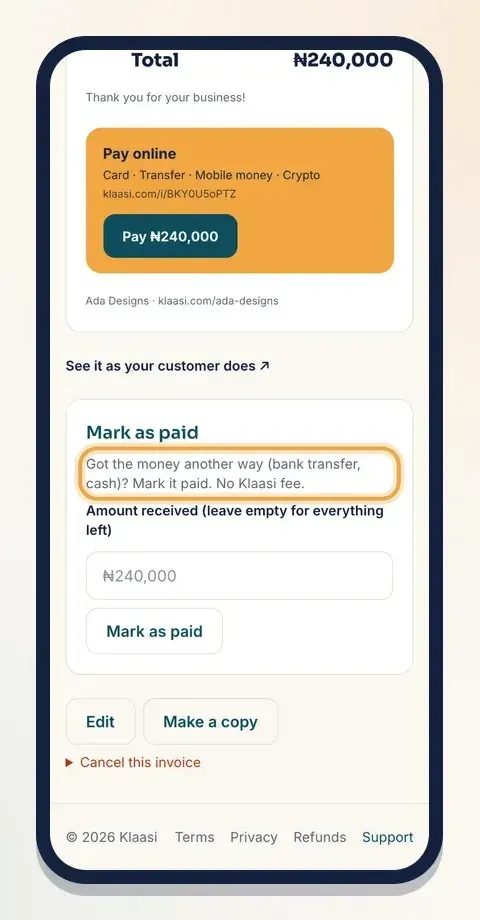
If your customer paid cash or sent a bank transfer, open the invoice and use Mark as paid. Type the amount you received, or leave it empty for everything that's left. There's no Klaasi fee on money you mark as paid yourself.
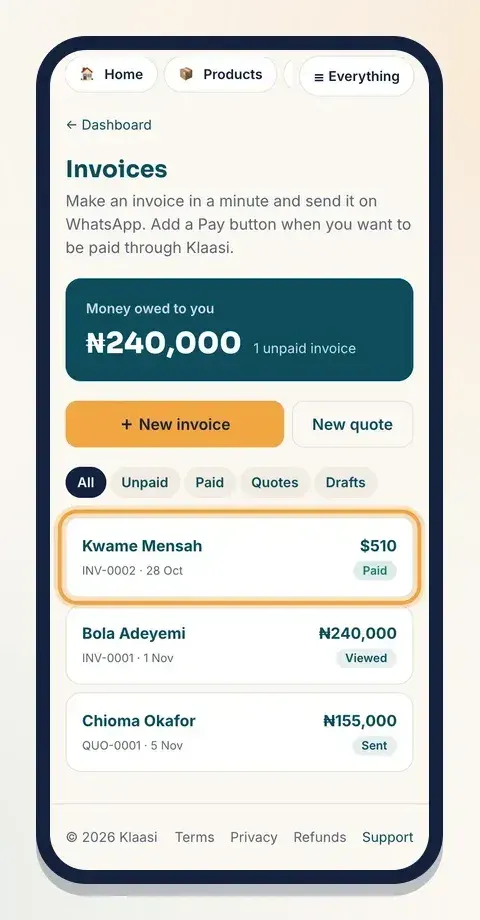
Once it's paid, the invoice shows Paid in your list, so you always know who has paid and who hasn't.
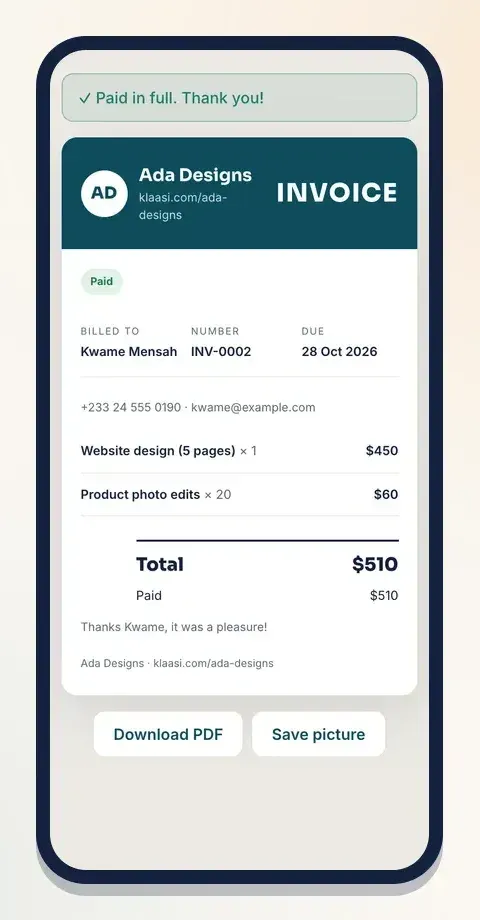
Your customer's invoice link then says Paid in full. Thank you!, with the total and the amount paid. When you've marked it paid yourself, Klaasi doesn't email a receipt automatically, so send the paid invoice to your customer: share the link, or tap Download PDF or Save picture and send it on WhatsApp or email. It has your business name, the invoice number, the items, the total and what was paid: everything a receipt needs.
On the Free plan you can make 3 invoices a month, on Pro 200, and on Business as many as you like. The full guide is how to send invoices on Klaasi.
Keep good records
Receipts are only useful if you can find them. A simple habit:
- Issue a receipt for every payment, even small ones.
- Keep a copy (paper, PDF or in your invoicing app).
- Once a month, check your receipts against what reached your bank, MoMo or wallet.
- Keep records for as long as your local tax rules require.
Quick checklist
- "Receipt" at the top, with a unique number.
- Your business name and contact details.
- Date of payment and the customer's name.
- Each item, quantity and price.
- Discounts, tax and delivery shown separately.
- Total paid, how it was paid, and any balance left.
- A thank-you note.
- A copy kept for your records.
A clear receipt takes a minute to write and saves hours of confusion later. If you'd rather not write them by hand, try Klaasi Invoices free and let your paid invoices do the job.
What to do next
Start selling on Klaasi, free
Your shop, courses, live classes and community in one place. Buyers pay in naira or dollars.
Open my free shopKeep reading
Making money online in Ghana: honest options and getting paid in cedis
Real ways to earn online from Ghana (skills, digital products, services and affiliate marketing), the scams to avoid, and how to get paid to mobile money or a bank in cedis.
Accept payments online from buyers anywhere: card, transfer, mobile money and crypto
Stop checking transfer screenshots. Here's how to take card, bank transfer, mobile money and crypto payments from buyers at home and abroad, and get the money out safely.
Affiliate marketing in Nigeria: earn without your own product
You don't need your own course or ebook to earn online. Here's how affiliate marketing works, how commissions are paid, and how to promote products honestly.